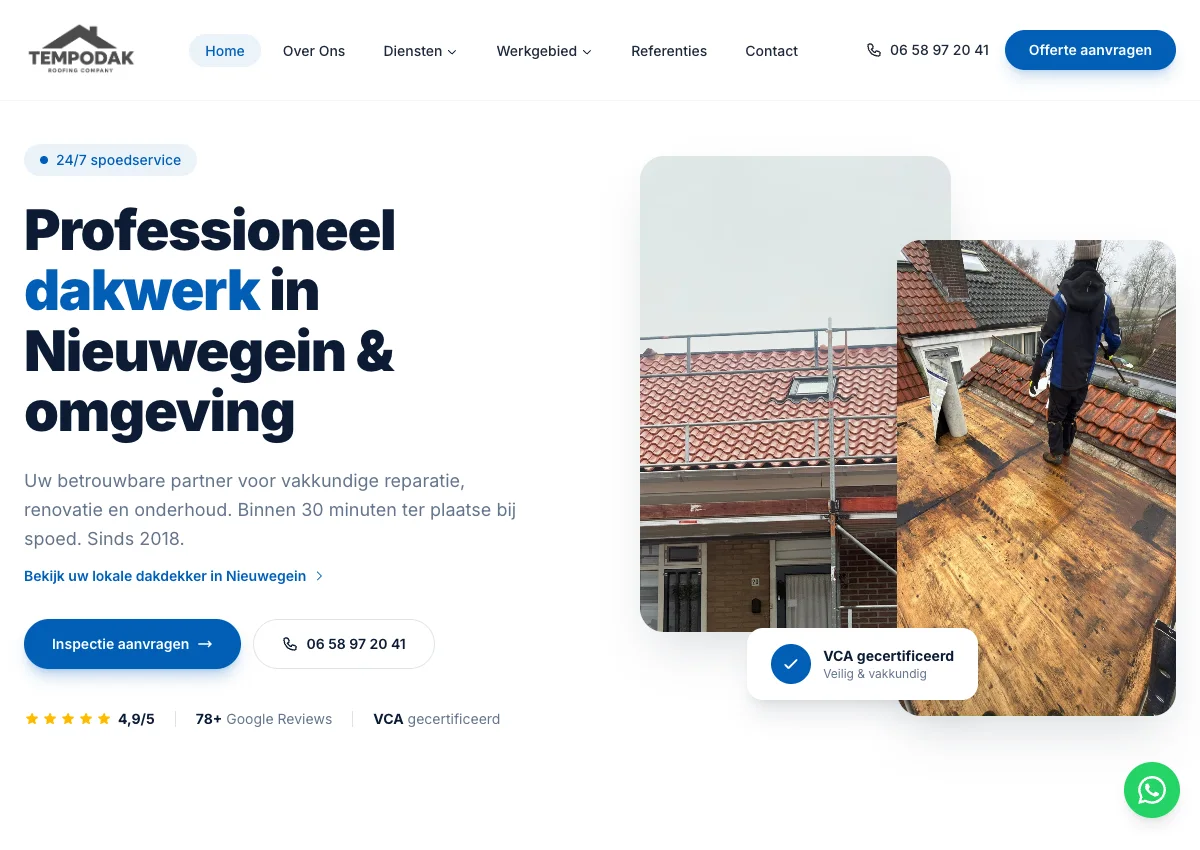
Visual impression. The real Tempodak work example appears below.
What you need to know
Does every enquiry have someone responsible for the next step?
First assess the requested work, location, timing and your capacity. Assign one person to follow up and record the next agreed action. Separate received, suitable, inspection, quotation and accepted work so you can see where requests are waiting.
01
Ask what is needed for an initial assessment; leave technical decisions to the roofer.
02
A receipt confirms arrival of the message, not a visit or emergency attendance.
03
Give each quotation an agreed follow-up point and a responsible person.
04
Do not count the same job again when someone also calls or sends another message.
An enquiry is dealt with when it has a clear next step or a recorded closing reason.
An example of our work
Work in practice
A real roofing business. Tempodak.
Completed website providing an online contact route
Tempodak is used only as a website example. The assessment and follow-up process is a practical proposal, not a claim about automation or measured results at this client.
Ask about the problem or planned work, the roof type if known, the property location and when the person can be contacted. Let them explain whether this is an active leak, routine maintenance or a future project. Record uncertainty instead of guessing a roof type or cause.
Only request existing photographs or pictures that can be taken safely; do not ask someone to climb onto a roof for a form. The first intake organises the request. Technical assessment and decisions about repair, inspection or replacement remain with the roofing business.
02
Decide whether the work fits your business
Compare the request with your services, coverage, roof types and available crew. Work outside your specialism is different from suitable work that you can only schedule later. Record these separately so temporary lack of capacity does not turn a suitable enquiry into a bad one.
For planned work, ask who can discuss and approve the job. An occupier, landlord and property association may have different roles. Keep the first assessment practical: enough detail for the right person to return the call, without demanding a complete customer file.
03
Assign one person and a realistic contact window
Agree who checks incoming messages when the person doing the work cannot answer. Decide what happens outside opening hours and who reviews missed calls. An acknowledgement can confirm receipt and explain when contact is expected, provided this matches actual staffing.
An automated message must not imply a confirmed inspection or an available emergency crew. Update the expectation if you cannot meet it. Keep contact attempts on the same enquiry instead of creating another lead for every message.
04
Be clear about what an inspection confirms
When a visit is needed, confirm the date, contact person, address and access. Explain what the inspection will cover and the actual costs or terms agreed beforehand. Do not call an inspection free unless that has been established.
An inspection appointment is a stage in the process. It does not yet confirm a start date for the work, a technical solution or a final price. After the visit, the roofer records what is needed for a quotation and who will provide any missing information.
05
Keep the quotation tied to the assessed job
Check that the quotation clearly describes the assessed work, included tasks and relevant exclusions. The roofer determines materials, working methods and technical conditions. Include which timing can actually be discussed and what still requires confirmation.
When sending the quotation, ask when the customer would like to discuss it. Record that point on the enquiry. A sent document without an owner or next action can sit untouched while each person expects the other to respond.
06
Follow up with a specific question
Use the agreed contact point to ask what is still missing: is the scope clear, does someone else need to decide, or is the timing unsuitable? Record any revision or new agreement and confirm it where needed. Repeated calls without a new purpose do not improve the assessment.
If the person declines, record the reason they give. For postponed work, agree whether and when further contact is wanted. No response, unsuitable work, a later discussion and a rejected quotation are different outcomes; do not merge them into one category of bad leads.
07
Give each measured stage a fixed meaning
Use a recognisable enquiry reference and record progress: received, contacted, suitable, inspection confirmed, quotation sent and work accepted. A telephone-link click does not prove a conversation. A quotation request does not prove a quotation, and accepted work does not prove payment.
Google Ads distinguishes qualified and converted leads using stages in your own process. Choose a definition you can record consistently. Feeding outcomes back to advertising requires separate checks of setup, data use and operation; a list of statuses does not activate an integration.
08
Use the drop-off to improve one stage
Review enquiries by work type and arrival period. Unreachable contacts need a different investigation from quotations still awaiting a decision. Keep missing data marked as unknown and combine repeated messages about the same job. A recent group should not be judged against an older group that has had more time to decide.
For an initial discussion, bring a summary without personal data: work type, known source, current stage, next action and closing reason. We can then discuss the website, responsibilities or measurement. Availability of our help is discussed by service and area, including Utrecht; no start date or automated follow-up is promised.
FAQ
Good to know.
Should every roofing enquiry lead straight to an inspection?+
No. First establish the requested work, property location and who can assess it. The roofing business decides whether a conversation, more information or a visit is needed.
What response time should we promise?+
One that your actual staffing can support. Distinguish acknowledgement, a return call and attendance. Do not adopt a universal number of minutes without knowing your own availability.
Does a long call mean a good lead?+
Call duration alone does not establish suitable work or a future job. Record the need and outcome, using duration only as an additional signal.
Can we start without a new CRM?+
Yes. A restricted overview and clear ownership can establish the process first. Show personal data only to people who need it for their work. Automate a process once its meaning is clear.
Google distinguishes lead stages aligned with your sales process. The intake questions and follow-up sequence are our practical application. The source is in Dutch.
Checked on 2026-10-18
Contact
What fits your roofing business?
Tell us what work you want to take on and where you work. We will discuss what fits.